
BMS SOFTWARE PLATFORM

SBS SOFTWARE PLATFORM
ASIL D BMS software framework. One software, every variant. Reconfigured by parameter — no rebuild, no re-qualification.

THE CHALLENGE
WHY CURRENT BMS SOFTWARE DOESN’T SCALE
OEMs and Tier 1 suppliers need one BMS that works across their entire battery portfolio. Different cell suppliers, different pack architectures, different markets — but consistent behavior and one engineering team.

VARIANT FORKS
Each battery variant gets its own BMS software. Different cell chemistry means different algorithm tuning. Every variant becomes a separate code fork with its own build, QA, and certification path.
SEPARATE CODEBASE PER VARIANT

CERTIFICATION BOTTLENECK
Safety and application code are entangled. Changing a QM parameter — switching cell supplier, adjusting a threshold — can trigger full safety re-assessment even when the safety logic is untouched.
FULL RECERTIFICATION FOR QM CHANGES

LINEAR COST GROWTH
Bug fixes ported across forks. Certification repeated per variant. One-time engineering efforts, time-to-market, and certification bottlenecks compound with every battery system added to the portfolio.
6 - 12 MONTH RELEASE CYCLES
PLATFORM ARCHITECTURE
SEPARATION
Built with strict partitioning on a single controller, our BMS safely isolates the safety software. This safe-by-design setup enables you to develop and deploy your own custom QM applications, letting you innovate freely without impacting safety compliance.
SEPARATION OF CERTIFIED AND QM CODE
The certified core — ASIL D safety, ISO 21434 cybersecurity, and homologation functions — is encapsulated behind an FFI barrier. QM code can be modified without impacting certification.
MULTI-VARIANT BINARY
A single compiled binary contains multiple battery system variants, selected at runtime. All variants compiled from the same source tree — no variant-specific branches.
SEPARATE CONFIGURATION FILE
Parameters are stored independently from the binary and can be flashed without changing it. QM parameters have zero certification impact.
FLASHABLE INDEPENDENTLY
CONFIGURATION FILE
Safety + QM parameters, separate from binary
CHEMISTRY
THRESHOLDS
COMM
TOPOLOGY
BALANCING
DIAG
QM APPLICATION LAYER
APPLICATION CODE
SOC / SOH / SOP | Diagnostics | Balancing | Communication
ENCAPSULATED
CERTIFIED CORE
SAFETY (ASIL D)
CYBERSECURITY (ISO 21434)
HOMOLOGATION
FFI BARRIER - FREEDOM FROM INTERFERENCE
HARDWARE ABSTRACTION
HAL - UNIFIED API
Across all SBS variants + CMBs
SBS CORE
+ CMBs
SBS HIGH
+ CMBs
MULTISTRING
+ CMBs
STATIONARY
+ CMBs

PLATFORM VALUE
BUILT FOR SPEED
Faster time-to-market, lower engineering cost per variant, and a single platform that scales across your entire product portfolio.
14-DAY RELEASE CYCLES
Hardware, software, and cloud engineered as one integrated system. Every layer is designed to work together, eliminating interface gaps and reducing integration risk for your battery pack.

ALL VARIANTS, ONE RELEASE
A single software binary runs across every BMS controller variant. Runtime configuration replaces custom builds, cutting validation effort and accelerating time-to-production with 14-day release cycles.

PARAMETER RECONFIGURATION
Cell monitoring designed to ASIL D, ISO 26262 software processes, and cybersecurity by design. Proven in series production for heavy-duty trucks and ready for utility-scale BESS deployments at 1500V.

CONFIGURATION FRAMEWORK
FOUR LEVELS OF CONTROL
Parameters are classified by certification impact. Level 3 covers the majority of what changes between battery system variants — cell chemistry, algorithm tuning, communication setup — so most adaptation happens at the speed of configuration, not certification.
LEVEL 3 — NO RECERTIFICATION IMPACT
Cell chemistry profiles (NMC, LFP, NCA) with OCV curves and impedance models
SOC/SOH algorithm parameters and cell model tuning
Diagnostic warning thresholds and logging configuration
Communication settings (CAN IDs, Modbus addresses, baud rates)
Balancing parameters (start threshold, strategy selection)
Calibration parameters (capacity, sensor offsets)
LEVEL 1: FIXED
Core certified parameters — contactor control logic, fault reactions, hardware safety mechanisms, cybersecurity mechanisms, homologation-relevant functions. Hardcoded in binary, not configurable.
ACCESS: NOT CONFIGURABLE
IMPACT: CERTIFIED, ENCAPSULATED
HARDCODED
LEVEL 2: RESTRICTED
Safety- or cybersecurity-relevant settings — pack topology, safety-relevant voltage/current thresholds, balancing mode selection where mode switching affects safety paths.
ACCESS: CONFIGURABLE WITH ME APPROVAL
IMPACT: REQUIRES IMPACT ANALYSIS
ME APPROVAL
LEVEL 3: CONFIGURABLE
Application parameters — cell chemistry, SOC/SOH algorithms, diagnostics, communication settings, balancing, and calibration. Configurable with no recertification impact.
ACCESS: CONFIGURABLE
IMPACT: QM - NO RECERTIFICATION
NO RECERTIFICATION
LEVEL 4: DEVELOPMENT
Debug and test parameters. Available during development only. Not present in production releases.
ACCESS: DEVELOPMENT ONLY
IMPACT: N/A
DEV ONLY
The SBS (Smart Battery Sensor) Software Platform runs on ME's entire SBS hardware family. All variants share the same software platform — the HAL abstracts hardware differences so customer application code is identical across variants.
HARDWARE PORTFOLIO
VARIANTS
| SBS High | BMDU (Battery Management & Disconnection Unit) | SBS Core | |
|---|---|---|---|
| Role | Centralized controller for modular architectures with external switching | Integrated controller + power distribution with built-in Eaton Breaktor | Compact controller for standard applications |
| MCU | Infineon AURIX TC377TP (3-core, 6 MB flash) | Infineon AURIX TC387QP (4-core, 10 MB flash) | Infineon AURIX TC377 (3-core, 6 MB flash) |
| Contactor Drivers | 7 (6x normal + 1x PWM) | 3 (Pack+/- via Breaktor + 1x external) | 6 |
| Short-Circuit | Pyro driver with backup capacitor | Eaton Breaktor — resettable, up to 25 kA, 10 ms interruption | Pyro driver with backup capacitor |
| HV Measurements | 8 channels (2 pack + 6 generic) | 3 channels (Pack+, Pack-, Differential Link) | 6 channels (2 pack + 2 DC link + 2 diagnostic) |
| Current Sensing | Integrated 35 μΩ dual shunt, ±1000 A | Integrated 35 μΩ dual shunt, ±1000 A (350 A cont. / 650 A peak) | External sensor compatible, ±1000 A |
| CAN | 3x CAN FD (5 Mbit/s) | 3x CAN FD (5 Mbit/s) | 3x CAN FD (5 Mbit/s) |
All variants operate at -40 to +85 °C, support Secure Boot / Secure Update / HSM, and share a voltage measurement architecture.

CELL MONITORING
FLEXIBLE CMB PORTFOLIO
The CMBXX family comprises 15+ cell monitoring board variants that can be combined with any SBS hardware variant. All managed by the same software platform — the HAL abstracts CMB differences, and the Configuration Framework adjusts monitoring parameters automatically.

6 TO 112+ CELLS PER CMB
CMB6 through CMB112 — matched to your module design. 15+ variants available.

ANY CHEMISTRY
NMC, LFP, NCA, solid-state — software-configurable via Configuration Framework.

PASSIVE AND ACTIVE BALANCING
Passive balancing up to 300 mA, or active balancing up to 3 A.

ELECTROCHEMICAL IMPEDANCE SPECTROSCOPY
live onboard EIS for SoX improvement, fault detection, fast charging and early thermal event detection.

1500V ISOLATION
isoSPI, isoUART, daisy-chain communication. 1500V isolation for stationary applications.
RELEASE PROCESS
FROM DEVELOPMENT TO RE-RELEASE
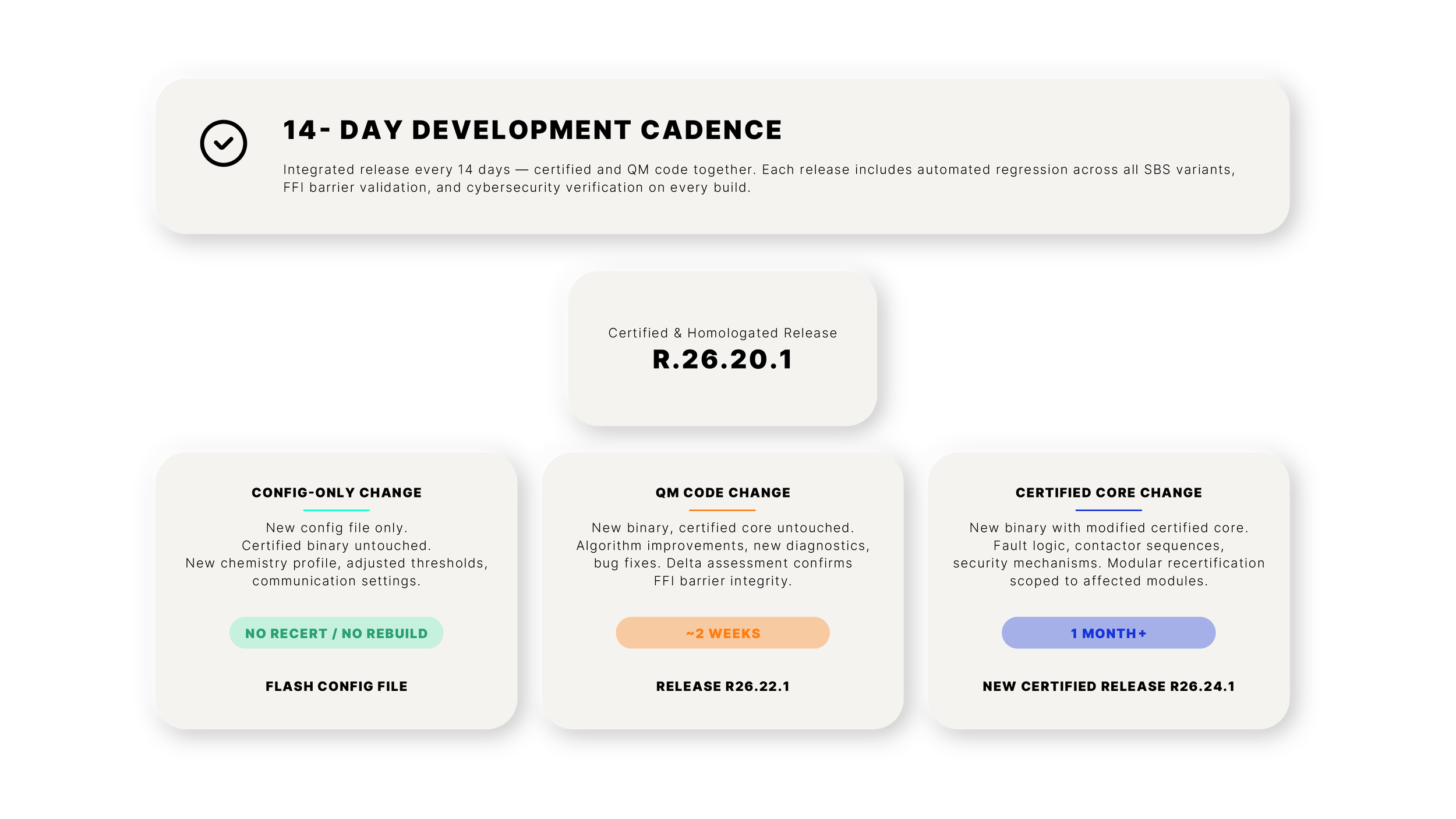
The platform produces an integrated release every 14 days during development. After certification, the architectural separation enables fast re-release paths depending on what changed.
READY TO UNIFY YOUR BMS SOFTWARE?
The SBS Software Platform is production-ready. One binary, 14-day release cycles, and the Configuration Framework — built to accelerate your battery program.