
MUNICH ELECTRIFICATION DEMONSTRATES THE INFLUENCE OF BATTERY MANAGEMENT SYSTEMS ON THE PROFITABILITY OF LARGE-SCALE STORAGE
PRESS RELEASE
At ees Europe, the Munich-based BMS specialist will show how greater precision in measurement technology reduces capital costs and increases the earning potential of BESS.
Munich, April 22, 2026 – At ees Europe (June 22–25, 2026, Messe München, Hall B2, Booth 190), Munich Electrification will demonstrate how precision determines the economic efficiency of utility-scale battery energy storage systems (BESS), and how system security and the “Made in Europe” aspect can optimize financing and insurance costs.
As cell costs decrease, electronics and software move to the center of investor interest. The accuracy of State-of-Charge (SoC) and State-of-Health (SoH) monitoring, along with system architecture, directly impacts investment costs, returns, financing terms, and insurability.
“A 100 MWh storage system can generate over one million Euros in additional revenue over 15 years. The basis for optimizing profitability: precise State-of-Charge and State-of-Health data. At ees Europe, we will demonstrate how powerful algorithms transform stationary storage into a predictable earning machine and why measurement accuracy is real money," says Timo Völkl, CTO of Munich Electrification (ME).
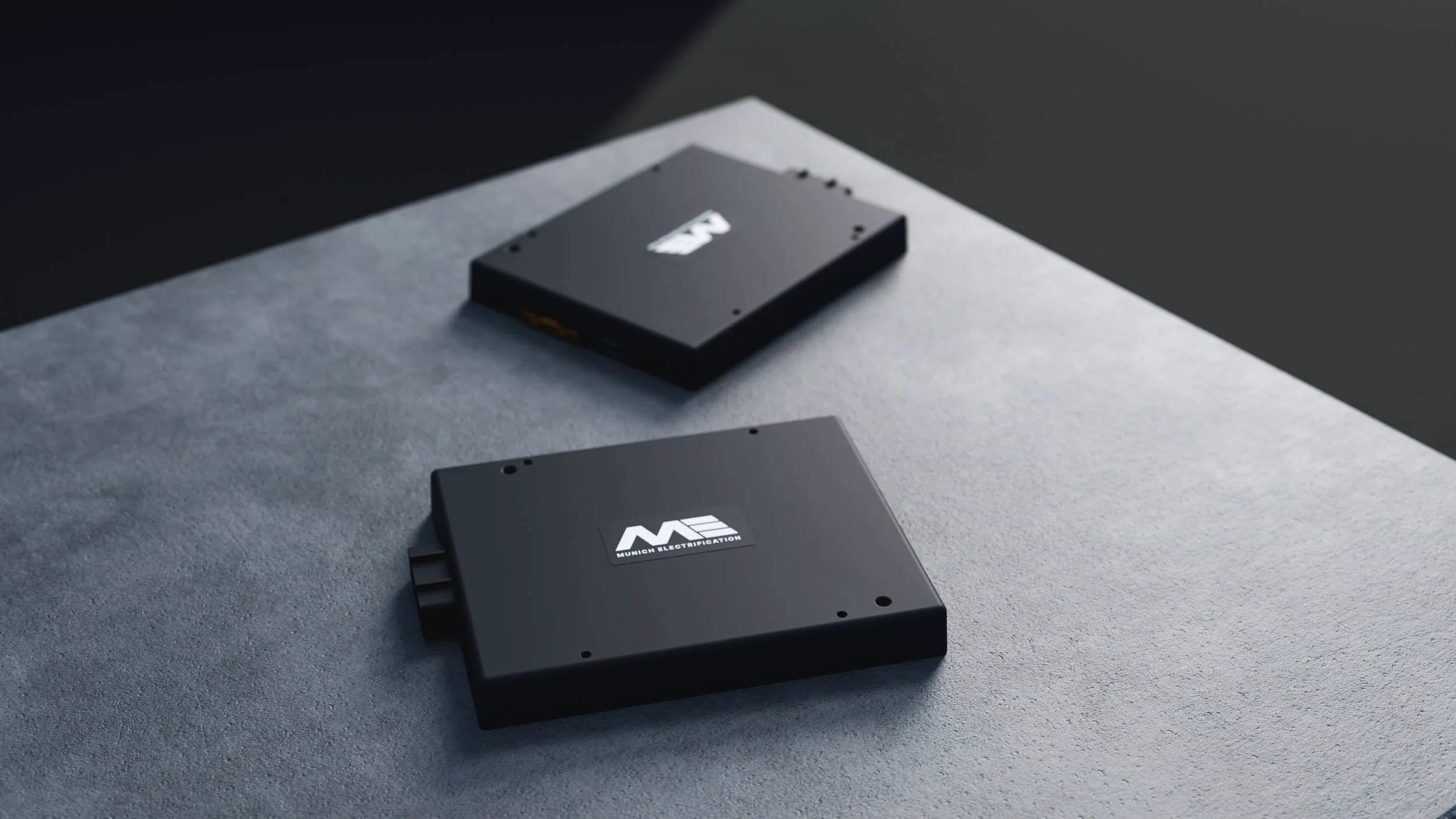
Munich Electrification offers battery management systems for stationary energy storage up to 1500 VDC with optimized SoC, SoH and balancing algorithms.
THREE LEVERS FOR BESS PROFITABILITY
ME identifies three ways modern BMS increase profitability – calculated based on a 100 MWh large-scale storage system over a 15-year lifespan:
1. Lower Initial Investment through Optimized System Design – Savings up to €500,000 per 100 MWh¹
Many BMS manufacturers tolerate SoC estimation errors of 5% and enforce correspondingly large safety buffers – capacity is installed but remains unused. The ME BESS BMS for 1,500V applications utilizes high-precision analog dual-shunt sensor technology to achieve SoC accuracy of ±2% or better. This makes it possible to reduce safety buffers in design and thus investment costs.
2. Increased Revenue through More Tradable Energy – Earning potential approx. €65,000–€130,000 p.a. for a 2-hour system (50 MW / 100 MWh)²
Inaccurate state predictions require operational safety buffers, which limit the amount of tradable energy, as shortfalls in energy trading result in contractual penalties. ME’s software uses adaptive algorithms for precise real-time state determination – directly within the BMS, not only downstream like with cloud analytics solutions that attempt to correct errors with limited information. The ME software creates a high-frequency real-time data basis that automatically improves trading decisions via EMS, SCADA, and trading platforms and maximizes tradable energy.
3. Profit Maximization through Active Balancing – Potentially approx. €450,000 additional revenue over 15 years
Passive balancing approaches dissipate excess energy as unused waste heat. In contrast, ME’s active balancing technology distributes energy in real-time from stronger cells to weaker cells. This prevents the "weakest link" from limiting the entire system's performance and increases the amount of tradable energy.
In total, these three levers yield an added value of more than €1 million per 100 MWh over 15 years.
ADDITIONAL BENEFITS OF THE MUNICH ELECTRIFICATION BMS AND "MADE IN EUROPE"
ME develops and produces its BMS platform entirely in Europe. This ensures independence, reduces compliance risks, and, for example, prevents costly "rip-and-replace" component exchange in the event of geopolitical trade restrictions.
In addition to functional safety, ME pursues a consistent "Secure-by-Design" approach: Secure Boot, Secure Update, Secure Access, and encrypted communication are integrated into the hardware and developed according to the highest cybersecurity requirements. The resulting security architecture – combined with high-precision state data – not least creates a robust foundation for banks and insurers. This is a crucial factor for attractive financing conditions and long-term project stability.
MUNICH ELECTRIFICATION AT EES EUROPE 2026
At ees Europe (Messe München, June 22–25, 2026), Europe's largest trade fair for energy storage systems, Urs Kalt will highlight the strategic importance of Security-by-Design for critical energy infrastructure in the conference presentation "How BMS Enable BESS Resilience of Critical Infrastructure" (June 22, 3:45–4:45 PM, ICM Room 13B). At the Booth in Hall B2 / 190, ME experts will provide information on BMS solutions for optimizing investment costs, profitability, safety, and the lifecycle of large-scale storage systems.

Munich Electrification offers battery management systems for stationary energy storage up to 1500 V DC with optimized SoC, SoH and balancing algorithms.
ABOUT MUNICH ELECTRIFICATION
Battery Management Made in Europe – Munich Electrification GmbH (ME) has been developing Battery Management Systems (BMS) for electric mobility and stationary battery energy storage systems (BESS) since 2015. ME covers the entire spectrum with hardware, software, and sensor technology – from cell monitoring and current sensing to functional safety.
In the automotive sector, ME systems are used in series vehicles by leading OEMs. The BMS platform supports voltages up to 1000 V and is designed for rapid adaptability to diverse battery architectures.
https://www.munichelectrification.com/automotive-battery-management-systems
For high-voltage BESS applications up to 1,500 V DC, ME provides the technology necessary for stable grid operations, effective peak shaving, and the transition to renewable energy. High measurement accuracy and remote monitoring enable operators to reliably monitor the state throughout the entire life cycle.
https://www.munichelectrification.com/stationary-storage-bms
More about the company: www.munichelectrification.com
Image Material: https://www.munichelectrification.com/media-hub
Sources
¹ Based on EU system costs (€130–170/kWh installed, Bloomberg NEF 2025) and a reduction of the SoC estimation error by 3 percentage points (5% → < 2%).
² Bandwidth dependent on market conditions and trading model. Based on published industry analyses (Modo Energy, 2025) on the correlation between SoC accuracy and trading revenues in the energy arbitrage market.
³ Combination of Capex savings (~€500,000) and cumulative additional revenue over 15 years. Conservative estimate; insurance and financing benefits not quantified.